Wednesday, September 30, 2015

An Unusual Objection to Less Parking: It Will Make Our City Too Nice

The college town of Champaign, Illinois recently debated against a relaxed parking requirement for residential development. From a planner and developer perspective, reducing the parking requirement is about lowering development costs, reducing auto dependence, and improving the attractiveness of the community. From the university's perspective, the idle lots being suddenly viable for development poses development competition where they seek to buy lots on the cheap for future expansion. ultimately, the city didn’t change anything in response to the university’s objection, (adding, “we are hoping to work more closely with them in the future”).

Some thoughts from this article:
The argument against the policy, in this case, is actually a powerful one in its favor. The University understands the benefit of parking and acknowledge that their primary reason for objection is to preserve cheap land for future university development.  

It is interesting that when the city has reduced parking requirements in the past, the development community has made instant use of the changes.  This is an indication that developers were very eager to be relieved of this huge cost burden on them.  Given the receptivity of the developers it is no wonder why the university objects the proposal.

The interest of the university is a lot of times at odds with the city.  Universities are also businesses that bring a lot of income to the city.  Keeping the university happy should be a priority for city planners only up to a certain extent. Planners also need to consider housing and offering services to the city’s residents outside of the university community- i.e. low-income residents. When large institutions are bullies planners can leverage certain policies such as reduced parking requirement to have greater negotiating power.

Your thoughts?

Link: http://www.citylab.com/cityfixer/2015/09/an-unusual-objection-to-less-parking-it-will-make-our-city-too-nice/406096/?utm_source=SFTwitter

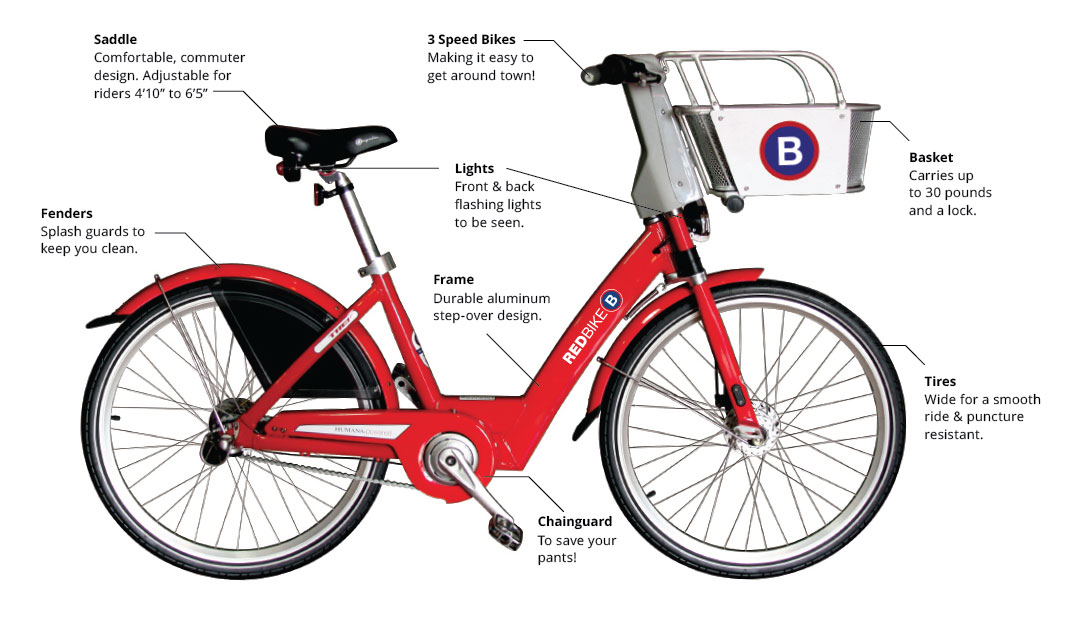
Low Cost Red Bikes Helps Low Income Area with Transportation Needs


 Low Cost Red Bikes Helps Low Income Area with Transportation Needs
Red Bike one a kiosk based bike rental service has teamed up with the Cincinnati CityLink Center which offers services to low income families to bring a discounted program to the area surrounding the center. An annual Red Bike membership is already cheaper than a monthly membership to the Metro bus pass, but with partnership at the CityLink center qualifying applicants can get an annual Red Bike membership for just $5.00, that's instead of the regular price of $80.00. My thought is that offering a low cost transportation solution to low income areas s a good idea because the bikes are cheaper than a bus pass, or ownership of a car. Also in low income neighborhoods many people might be hesitant to own there own bikes because the chance of theft, while with the Red Bike the bikes are easily identifiable in case of theft. This takes cars off the roadway improves and could lead to improved community communication and iteration, and also to the chance of changing the modal transportation needs of the area. Thinking broader than transportation the health benefits of transferring people to a non workout based transport to a workout based one such as biking will bring the healthcare costs of the community down over time. Also this community is very low income and has a high number of people going hungry, but also in these communities usually there is a high consumption of non-nutritious foods which effects there health in a negative way. Saving money on transport and increasing health through biking could jump start the area to flourish.


RedBikeDetails

LINK TO ARTICLE ON WEBSITE OF WPCO NEWS CINCINNATI, OH

Coronado rises up against bike lanes and 'paint stripe pollution'


The brouhaha in Coronado shows what a vocal minority can do:
http://www.sandiegouniontribune.com/news/2015/sep/23/coronado-bike-lanes/
http://www.kpbs.org/news/2015/sep/23/coronado-puts-brakes-all-future-bike-lanes-after-r/

Here are the insane things people opposing bike lanes have to say when they have no real argument:
  • Gerry Lounsbury: “You are covering Coronado with paint stripe pollution.”
  • Aileen Oya: “The graffiti on the streets does not help our property values.”
  • Carolyn Rogerson: The lanes “bring to mind a visual cacophony that if you look there long enough it will induce a dizzying type of vertigo.”
  • Gerry MacCartee: “These black streets with these brilliant white lines everywhere ... it takes away from your home, from your outlook on life.”
  • Darby Monger: “It’s very similar to personally taking all three of my daughters to a tattoo parlor and having them completely body tattooed.”

Monday, September 28, 2015

Integration of Computers into Cars

I've noticed a few posts about intelligent designs of vehicles and their operating strategies, like Uber. Newer cars are integrating more and more computers into their system, and that means programs of code.


This article highlights the possibility and proven capability of vehicles being hacked into, even if codes are secret. A generation ago, the radio, ignition, lights, air conditioning, were all separate. New cars have a centralized system using the computer as the brain. How do you feel about buying a car that relies on a computer to start?

http://www.nytimes.com/2015/09/27/business/complex-car-software-becomes-the-weak-spot-under-the-hood.html

Saturday, September 26, 2015

EPA Beefing Up Emissions Tests in Wake of VW Scandal

VW vehicles wait to be shipped in Villers-Cotterets, Germany. The company installed software in its "clean diesel" vehicles to cheat on U.S. emissions tests.

     As everybody known, people are willing to buy Germany vehicle because they have better engineering technology. However, they develop their technology in wrong way.
     VW and Audi may ultimately face a penalty of up to $18 billion, or $37,500 per vehicle in violation. By comparison, Hyundai and Kia were penalized $300 million last year for overstating vehicles' fuel economy and greenhouse gas emissions.
     We should worry about does any else companies also have the emission problem that we still didn't find out? Why they choose to cheating on the emission test?

http://www.usnews.com/news/articles/2015/09/25/epa-beefing-up-emissions-tests-in-wake-vw-audi-cheating-scandal

Should Uber Comply with ADA (Americans with Disabilities Act) Laws?


Published May 2015 http://www.thedailybeast.com/articles/2015/05/21/uber-disability-laws-don-t-apply-to-us.html


Should companies like Uber and Lyft be required to comply with ADA laws and accommodate the needs of all people? Currently, these companies are at the intersection of technology and transportation, and courts are settling whether they are software or transportation companies.

When it comes to fairness and equality, they find themselves in a grey area and many disability activists argue that regardless of politics and laws, Uber should help make transportation options available to all individuals. Should Uber be considered a taxi service with a fleet of drivers? Therefore, should it have legal or contractual duties to comply with the law?

Late last year Uber was involved in a lawsuit with the National Federation of the Blind in California in which the argument consisted of many violations of the Civil Rights Act. According to the U.S. Federal Code of Regulations for Transportation, companies like Uber cannot contract away their ADA responsibilities.

States are also struggling with these companies existing outside the realm of state regulation. A recent act introduced in various state legislatures mentions that companies such as Uber can direct disabled passengers to alternate providers with wheel-chair accessible services, if they cannot themselves accommodate for these services. This worries disability activists because it might exempt Uber from complying with ADA or by confusing drivers about their responsibilities to accommodate everyone.

The questions above open the discussion on ride-sharing and other alternative modes of transportation and level of accessibility for all individuals. To what extent should laws and regulations apply to all alternative modes of transportation now and into the future?

Monday, September 21, 2015

Streetscape Tranformation - Before and After Photos


CityLab had a short article on this photo collection from a group in Brazil (URB-I).  The before and after photos are a fantastic resource of ideas and dramatically illustrate the potential of transforming our public space.


Here is the link to the site: URB-I Before and After Photos

Tuesday, September 15, 2015

Top 10 Most Dangerous Cities for Red Light Running (Tucson #9, Phoenix #2)


Red light running is becoming very common on a daily basis. Whether it is from being late to work or school, or just being stuck in the dilemma zone when the light is yellow, the results could be severe. The National Coalition for Safer Roads ranked all the cities in the United States based on the number of fatalities between 2004 and 2013. Unfortunately Phoenix was ranked at number two with 127 deaths and Tucson at number nine with 61 deaths. Arizona Department of Transportation reported in 2014 that 2653 crashed resulted in injuries because of drivers that failed to stop at a red light or stop sign. Pima County removed all the enforcement cameras within county in early 2014 because the county believed that the cameras served their purpose and drivers are now aware that they should not break the law. The county decided that having deputy patrol will be more effective but according to the number of fatalities and injuries in Tucson, it does not seem to be an effective approach. However the city of Tucson has 30 locations with red light enforcement, 13 of which are also for speed enforcement and for some reason drivers still manage to run the red light causing tremendous damage. In early 2015, all the red light camera funding have been rejected in the City of Phoenix. Arizona Senate committee has been working on banning red light cameras and electronic tickets. If a state has 2 cities that are ranked in the top 10 red light running fatalities, why limit or remove the enforcement? Shouldn't enforcement be emphasized?

Article: http://www.tucsonnewsnow.com/story/29747871/tucson-9-for-red-light-runners


Monday, September 14, 2015

Uber's Influence On Urban Design

Original post found on Planetizen


Both innovative and controversial, Uber has without a doubt shaken up the taxi industry. It has made an impact on the way people get around cities, and it has done so all without spending a dime on infrastructure. A major change in the way that uber vehicles are navigate through the city (which will be crucial when it makes the shift to driverless vehicles) is "smart routes." Rather than driving directly to any user that hails the car on the app, the smart route feature will suggest collection points for the vehicle based on the density of users requesting a ride, almost similar to the way a bus route works. This process reduces the amount of time the vehicle is driving to pick up multiple users, allows for more people to be transported over a given period of time, and would reduce the number of ubers on the road during peak hours.

As uber grows, or new competition arises, there may be increased competition for convenient curbside locations in places where people are regularly being picked up along a route. This would provide need for a new type of infrastructure to accommodate the massive demand for pickups at these nodes, and they can take the form of stations not dissimilar from a BRT station, or anything else the mind can imagine. If the general trend is for most people to choose foregoing car ownership during the onset of the self-driving car era, this demand could become very real - very quickly.


From the standpoint of a transit planner, this becomes very interesting. The problem can essentially be viewed from a reactive or proactive approach (or combination of the two). Do we monitor the areas that are receiving the most pickups and then install the infrastructure accordingly? Or do we encourage the development of specific TOD hubs, and implement the infrastructure there, allowing us to determine the more efficient location for this infrastructure?

New South Wales Roads Minister Wants to Destroy Cycling in Sydney


                                                                                    Cycling Protesters, Sydney, Australia        


Australia's self proclaimed "biggest bike-lane skeptic in the government" and New South Wales (NSW) roads minister, Duncan Gay, has made clear efforts to remove the College Street cycle path in the city of Sydney.
The protected cycle path, which allows bike commuters to easily travel through the city will most likely be removed in September 2015. According to Gay, This actions will "accommodate for more cars and buses, while improving the city's economy." 

This is a clear step-backwards for the city of Sydney, as cities throughout the globe seek to improve their transportation issues with better bike and pedestrian infrastructure, and not by getting rid of it.
Even though Sydney's bike commuters, and residents in general, have shown strong opposition to removing the path, it is very unlikely that it will remain in place.
Gay's reputation of "getting things done" and the support of one of Australia's main political party, The Nationals, gives Sydney's residents the feeling that the city's progressive attitudes have become regressive.


Link to the Article:

Just Move the Railroad

My hometown of Flagstaff, Arizona, is defined by a railroad.  It exists solely because of the railroad. And today, efforts to improve auto traffic flow through town and create safe and efficient bicycle and pedestrian infrastructure are made more complicated, perhaps impossible by the railroad.

Initially established as a depot for timber and sheep, Flagstaff grew in radiating patterns away from the train station.  Route 66, also a dominant feature that has deeply influenced Flagstaff's form, was built parallel to the railroad from one end of town to the other.  To get anywhere in Flagstaff requires driving either parallel to the railroad or crossing the railroad.  One bridge and one overpass are the only alternatives to several at grade crossings.  This is important because between 70 and 110 freight trains move through town each day.

The recent post on The Atlantic's City Lab: "Mapping the Urban Fingerprints of Cities" reinforces a crucial issue.  Form matters.  Form is produced by decisions, history, market forces and in the case of Flagstaff, a central feature that shapes and defines the city.

As transportation planners thinking about how to make cities safer, more efficient, and more conducive to non-auto modes, existing urban form has to be at the front of all planning efforts - and the local constraints (and opportunities) define everything.  The urban form can be changed to accommodate these new transportation goals, but it is expensive, destructive, and will never happen without a fight. (For a Tucson example of this, look to the history of the reconstruction of the 4th street and Congress intersection and underpass)

Flagstaff has made an effort for sure.  It's regional transit system is awesome for the size of community it serves and it has one of the best urban trail systems in the country. But for a region that has less than 100,000 residents, rush hour, lunch hour, the end of the school day and holiday weekends create snarling traffic conditions.

There are no easy answers - no matter how much money the city would be willing to spend or how much political consensus could be reached.  Just move the railroad.

Check out the article:

http://www.citylab.com/housing/2015/09/mapping-the-urban-fingerprints-of-cities/404923/

Sunday, September 13, 2015

The High Cost of Residential Parking


Inside a parking garage in downtown Iowa City / Phil Roeder


This article that has been posted on the CityLab website in May 2015 discusses the impact of residential parking on housing affordability. Cities impose minimum parking requirements on developers, which increase the development cost for the developer. As parking options become more complex, the development expenses increase and rents increase as well. Residential parking does not only impact housing affordability, it also decreases the number of developed housing units and the total number of available housing units. Do you think that eliminating the minimum parking requirements can increase housing affordability in cities, and can cities increase housing affordability by investing in public transit and decreasing the number of residential parking spaces?   

An enchanted bike path inspired by Van Gogh

"I can't change the fact that my paintings don't sell. But the time will come when people will recognize that they are worth more than the value of the paints used in the picture."
- Vincent Van Gogh


In the Netherland, Studio Roosegaarde unveiled the Van Gogh-Roosegaarde Bicycle Path in 2014, which is an enchanting kilometer-long bike path that is inspired by Vincent Van Gogh’s “Starry Night.” The path is decorated with special paint that illuminates after dark with the assistance of LED lights powered by solar panels. This is the second of Studio Roosegaarde’s five Smart Highway projects. The purpose of the Smart Highway projects are to develop creative road networks that are safe for cyclist and pedestrians alike, as well as the natural environment. Beyond the safety implications and environmentally friendly aspects these projects present to the community, this also can be an extraordinary motivator to get communities to be more active and less auto-dependent.

As more and more communities explore the various alternative modes of transportation, it would be curious to see what the implications and impacts decorated bike paths have on society. Would more people be inclined to ride bikes or walk rather than drive if there was an experience to be had? Would congestion and other issues revolving around auto-dependency lessen if there more paths existed that created a fun experience? Would local governments or transit authorities be willing to invest in illuminated pathways throughout the city if they encourage folks to use the automobile less?

I cannot help but wonder about the safety implications that paths such as the Van Gogh-Roosegaarde Bicycle Path might have on motorists. Would these pathways add to the number of distractions driver’s already face at any given moment when driving down the road? Would vehicular fatalities or injuries increase in areas where illuminated art inspired paths were present? I recognize that planning for the number of distractions a driver might encounter at any given moment might be ludicrous, but it is important to consider the implications that illuminated pathways might have in regards to vehicle safety. 

Personally, I feel that illuminated pathways are a brilliant idea that could attract people to certain places and transform the way people interact within spaces.

Check out more of Studio Roosegaarde's Smart Highway projects here.

Are Head-Up Displays another technological distraction for drivers?

T.J. Kirkpatrick for The New York Times
As technological advances continue to push the transportation industry to more complex systems, does safety need to be more of a concern? This article in the New York Times discusses one of the latest applications of these advances called a Head-Up Display. It is a projected image, usually of the speed and speed limit, displayed about six feet past the dashboard into the windshield of the vehicle. There is no federal regulation on these Displays. Research is currently underway with the extent of the distraction unknown at this point. Is this just another technological distraction for the already over-stimulated driver?

Washington D.C. Slides


Thursday, September 10, 2015

Louis CK on road rage (as promised)

Here is the 20th Century equivalent of the Goofy movie we saw in class last night.  Funny. But I think it captures a key features of road rage and aggressive driving: people are different when they get behind the wheel of a car and, as Mr. CK points out, this is precisely when we are at our most dangerous because we're controlling a hunk of metal that on average weighs about two tons.

[Optional viewing. Language may be offensive to some.]

https://www.youtube.com/watch?v=x8062QEFk5g


Wednesday, September 9, 2015

The insane reason why Chinese drivers intentionally kill the pedestrians they hit


In China there is a fairly common phenomenon where drivers who hit pedestrians often make sure the pedestrian is dead. This occurs because of laws on victim compensation which make the cost of killing a victim in a traffic accident relatively small, ranging from $30,000 to $50,000, while if the pedestrian is injured, payment is on a lifetime basis, in millions of dollars. 

This is a perfect example of how it is more economical to kill a human than injure them. 
However, this horrific phenomenon creates a society where human life is disposable. Oftentimes drivers make sure the person they've hit is dead by running over them multiple times, even if the pedestrian was initially only slightly injured. 

Welcome to the course blog for PLG/CE 468/568

The course blog is now up and running. Please begin posting as soon as possible. Remember, blog posts can be on any topic related to class. You can respond to an assigned reading or share and comment on a news story or other item relevant to the topics covered in class. Photos and maps are encouraged. Blog posts should be about 250 or 300 words. Looking forward to seeing your contributions! I'll walk you through the details of posting in class today.