Saturday, December 12, 2015

The Clearest Explanation Yet for Why Millennials Are Driving Less

This article discusses Millennial driving trends and the decline in Millennial driving in the U.S. The first theory is that demographic or economic factors are behind the decline in Millennial driving, such as increased schooling, decreased employment, and delay in marriage. The second theory suggests that Millennials have a different attitude toward cars than previous generations did at the same age. A third theory suggests that the decrease in driving has not been accompanied by an increase in other modes of travel or a decline in average trip length, meaning that younger Americans are increasingly going fewer places.

(Full article: http://www.citylab.com/commute/2015/07/the-clearest-explanation-yet-for-why-millennials-are-driving-less/398366/)


Friday, December 11, 2015

What's the Use for all this Space?

The Journal of the American Planning Association recently published a study that visualizes how parking has taken over the urban fabric of Los Angeles. A study conducted by Chester et. al (2015) found that over a 60 year period, L.A.s parking spots grew from 6 million to 18.6 million in number. The data accounts for residential off-street spots, non-residential off-street spots, and on-street spots.


The animated image above shows just how this growth of parking space consumes the urban landscape of Los Angeles. I think this graphic portrayal of the increase over time really demonstrates just how much the American society has grown dependent on automobiles. At the start and at the end of every vehicle trip there must be a parking space, so it's no surprise that automobiles consumes so much space in our landscape. The study goes on to show that the amount of space consumed by parking is 1.4 times more area than is consumed by roads which means all this space is consumed by stationary objects. It's rather ironic that so much space is reserved for metal objects when they are of no use to us.


Campuses stepping up walkability


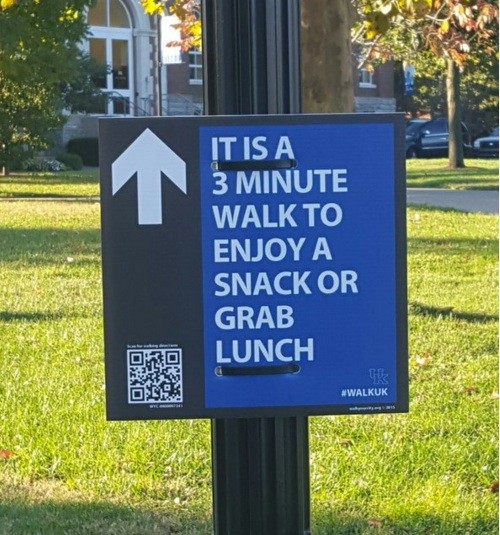
A new program at the University of Kentucky, modeled off the Walk [Your City] initiative, placed signs throughout campus that indicate the distance, in walking time, to nearby destinations. The signs say things like “3 minutes to lunch or a snack”, “8 minute walk to get a check-up”, and “16 minute walk to work out before heading home”. Each sign also has a QR code that can be scanned to input directions to the listed locations. The signs are designed to point out locations that may be closer by foot than people realized, thereby encouraging walking. Research has shown that these types of signs can have great results. A five month study by the CDC at an airport advertised to passengers in a terminal that it was just a five minute walk to the next terminal. Rates of walking over taking the tram increased by 14 percent. People are often so overscheduled now that these types of signs can be very useful in increasing movement by making it easier to choose walking.

So far the University of Kentucky is one of just a few campuses that have implemented this initiative, but 50 cities have joined since the program began in 2012. It was the idea of Matt Tamasulo, a then-grad student (now I feel like an underachiever! ) in Raleigh. Although city officials eventually took the signs down for violating a zoning ordinance, the city’s planning director was able to convince leadership to let them go back up as a pilot education project. Since then the program has continued to garner interest, with even the Surgeon General tweeting his support. In many ways, campuses are an ideal environment for these signs, as they are often like mini cities and struggle with parking availability.

Link: How colleges are stepping up campus walkability

Planners and Driverless Cars


An article on CityLab.com explores why planners aren't doing much to prepare for driverless cars. The author writes that as of mid-2013, only one of 25 MPO’s in large urban areas has even mentioned driverless cars in their plans. In speaking with planners, it seems part of the problem stems from the complete uncertainty about what a driverless car future will look like and how they will change people’s behavior. Large cities such as San Francisco and Seattle have done some studies, and conclude that vehicle miles traveled are likely to increase, not decrease, as people are willing to live farther out without an onerous and stressful commute. So on one hand it makes sense that planners would be hesitant to plan for a future that may look very different than what we can imagine now. On the other hand, these long range plans really do have to start thinking about these issues, as it’s beginning to affect current infrastructure and transit plans. Driverless cars will take up much less road space since they can travel close together. So construction now of adding more road capacity could be pointless from that point of view. Recently, a politician in Florida argued against a transit expansion, saying that with the driverless cars of the future, transit could become less necessary. What’s suggested now is for planners to concentrate on bridge repair and other similar infrastructure projects, as the need for those will not change with driverless cars.
Link to article: Why aren't planners preparing for driverless cars?

Wednesday, December 9, 2015

Some fun before the break - also, a tangent on wayfinding


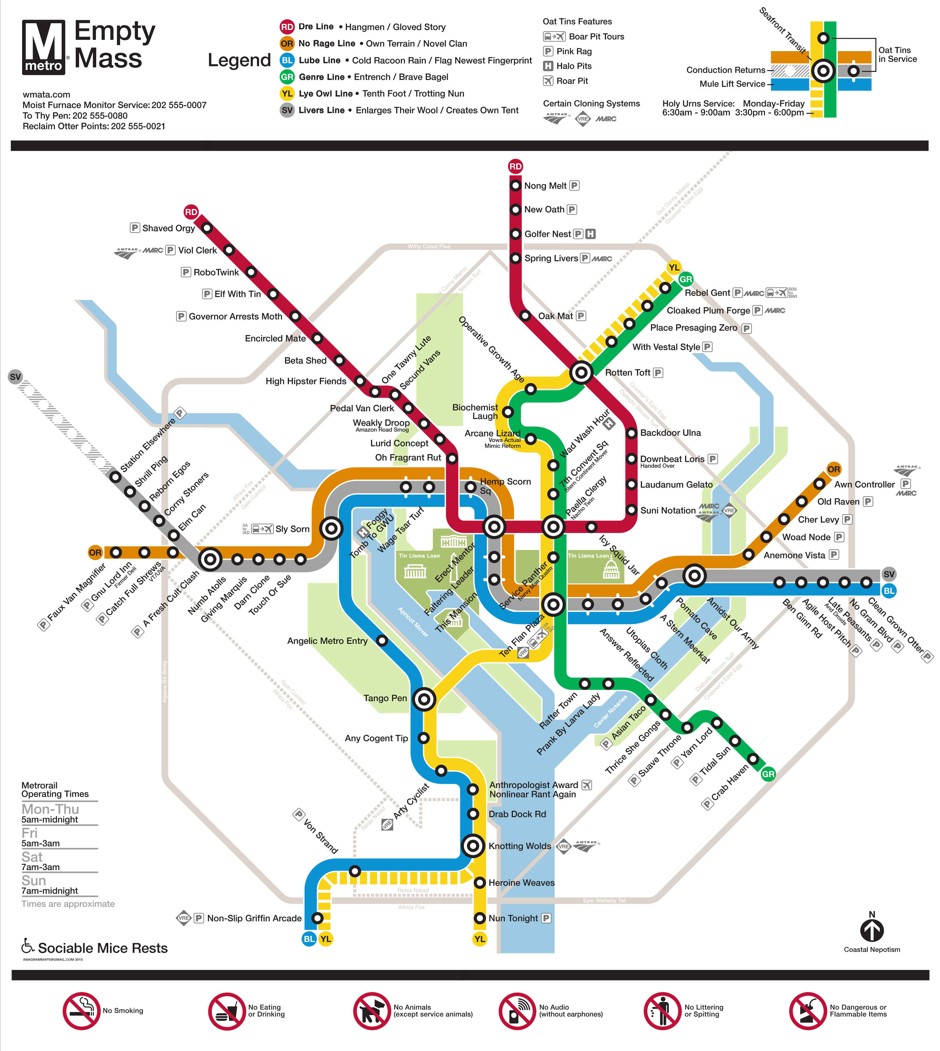
Reddit user CharonX took the Washington Metro map and made anagrams of all of the station names. Go to the link and look closely at it. It's fun. As someone who has been to DC and studied the real metro map many times, I find the anagrammetized version very disorienting. Signage, naming, and wayfinding are so important to transportation systems, but often overlooked. Many cities have tried to sell the naming rights to transit stations--though, usually with little success--showing a willingness to sacrifice the usability of a transit system for a little bit of money. Did you want to get to Pattison Street in Philadelphia? Well, don't go looking for Pattison station, because it's AT&T station now! If the names of stations are so disposable, why bother having any of the names relate to the geography surrounding the station at all?


Signage is another problem. Most high capacity transit systems have reasonably good signage, although it can still sometimes be tricky to figure out which train to take or if the next station is the one you've been waiting for. Buses are another matter. In Tucson, bus stops generally provide no information about the bus service at that location. Even where there are bus shelters with space to put useful signage, there is no indication of when the next bus is coming or where it is headed. Most people who ride the bus are probably familiar with their regular routes, and there are ride guides and apps that can demystify things. Should those tools be necessary? What if city streets were unmarked for drivers? Sure, you can memorize how to get certain places (I don't need signs to tell me how to get to work, to the store, downtown, friends' houses, and back home) or you can use a navigation app, but should that be necessary? Cities seem to treat non-drivers that way. In most cases, the reason is probably money. Every sign is an expense which is a target for vandals and thieves, and which must eventually be replaced either due to age or with a change in bus service.


For cyclists, particularly on routes that don't follow the street grid (such as neighborhood bike routes and greenways), signage can be nonexistent. This used to be the case on the river paths in Tucson, although since the paths were branded as the "Loop" and more resources have been devoted to expanding the system and improving the existing segments, some nice wayfinding signs have popped up over the entire route. Before then, the city and the county had spent millions of dollars to build and maintain the river paths but provided nothing to help riders figure out where they were going. The path forks in many places in ways that make it difficult or impossible to tell where the route is heading without proper signage.


Neighborhood bike routes are still plagued by a lack of information, however. The city has had bike routes throughout the city for decades, but has (until very recently) provided nothing more than the occasional enigmatic "Bike Route" sign, with no further explanation than maybe an arrow indicating that, in at least one direction, a bike route exists. Where does it go? What is it called? Will there be another sign to guide you on the next turn along the route? 


Fortunately, Tucson is adding better signage along enhanced bicycle boulevard routes. 
Unfortunately, these routes are still a very small part of the overall urban bike network in Tucson, and the growth of the bike boulevard network is likely to be slow. Still, it's a step in the right direction, and a sign that someone is paying attention.


Bonus: Here's an example of a sign that provides assistance to San Francisco bike riders trying to use the "Wiggle", a bike route that became popular organically due to the way it avoids steep hills in the area.


Smart City Challenge

The U.S. Department of Transportation has announced a contest centered around the idea of a “smart city”.  In a video introducing the contest, the Department of Transportation gives examples of things they consider part of a smart city, where “gridlock is gone, driverless taxis deliver you on time to train stations, [and] better roadways and vehicles communicate seamlessly”.  In addition, a focus on mitigating climate change is expected. The DOT is seeking out cities that have populations “between 200,000 and 850,000”.

Light Rail in Las Vegas?

The Las Vegas Regional Transportation Commission recently revealed a long-term transit plan for the city.  Included in the plan are potential improvements for roadways, as well as a proposal for a light rail system that would connect McCarren International Airport with the Vegas Strip and downtown Las Vegas.  The traffic in the Las Vegas area is projected to overwhelm the existing roadways, and light rail could potentially alleviate the the congestion facing Vegas’s most popular destinations.