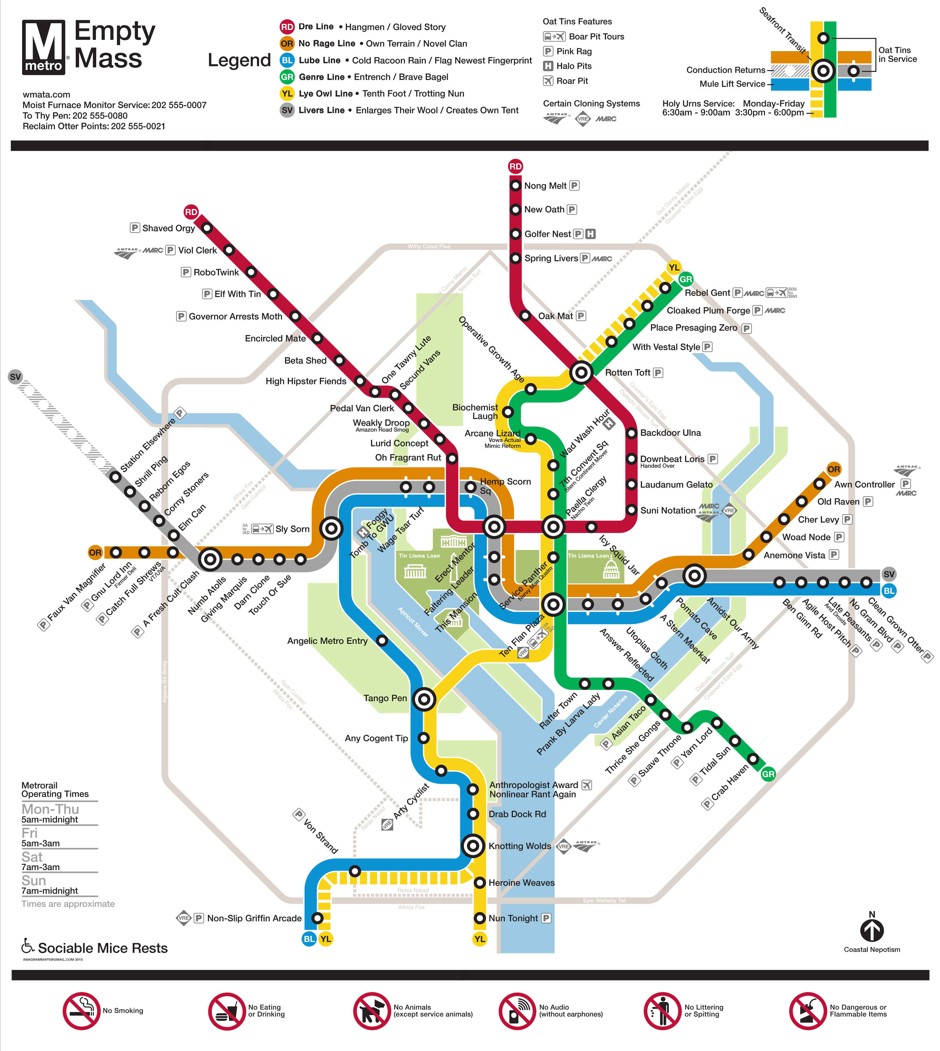
Reddit user CharonX took the Washington Metro map and made anagrams of all of the station names. Go to the link and look closely at it. It's fun. As someone who has been to DC and studied the real metro map many times, I find the anagrammetized version very disorienting. Signage, naming, and wayfinding are so important to transportation systems, but often overlooked. Many cities have tried to sell the naming rights to transit stations--though, usually with little success--showing a willingness to sacrifice the usability of a transit system for a little bit of money. Did you want to get to Pattison Street in Philadelphia? Well, don't go looking for Pattison station, because it's AT&T station now! If the names of stations are so disposable, why bother having any of the names relate to the geography surrounding the station at all?

Signage is another problem. Most high capacity transit systems have reasonably good signage, although it can still sometimes be tricky to figure out which train to take or if the next station is the one you've been waiting for. Buses are another matter. In Tucson, bus stops generally provide no information about the bus service at that location. Even where there are bus shelters with space to put useful signage, there is no indication of when the next bus is coming or where it is headed. Most people who ride the bus are probably familiar with their regular routes, and there are ride guides and apps that can demystify things. Should those tools be necessary? What if city streets were unmarked for drivers? Sure, you can memorize how to get certain places (I don't need signs to tell me how to get to work, to the store, downtown, friends' houses, and back home) or you can use a navigation app, but should that be necessary? Cities seem to treat non-drivers that way. In most cases, the reason is probably money. Every sign is an expense which is a target for vandals and thieves, and which must eventually be replaced either due to age or with a change in bus service.

For cyclists, particularly on routes that don't follow the street grid (such as neighborhood bike routes and greenways), signage can be nonexistent. This used to be the case on the river paths in Tucson, although since the paths were branded as the "Loop" and more resources have been devoted to expanding the system and improving the existing segments, some nice wayfinding signs have popped up over the entire route. Before then, the city and the county had spent millions of dollars to build and maintain the river paths but provided nothing to help riders figure out where they were going. The path forks in many places in ways that make it difficult or impossible to tell where the route is heading without proper signage.

Neighborhood bike routes are still plagued by a lack of information, however. The city has had bike routes throughout the city for decades, but has (until very recently) provided nothing more than the occasional enigmatic "Bike Route" sign, with no further explanation than maybe an arrow indicating that, in at least one direction, a bike route exists. Where does it go? What is it called? Will there be another sign to guide you on the next turn along the route?

Fortunately, Tucson is adding better signage along enhanced bicycle boulevard routes.
Unfortunately, these routes are still a very small part of the overall urban bike network in Tucson, and the growth of the bike boulevard network is likely to be slow. Still, it's a step in the right direction, and a sign that someone is paying attention.
Bonus: Here's an example of a sign that provides assistance to San Francisco bike riders trying to use the "Wiggle", a bike route that became popular organically due to the way it avoids steep hills in the area.


No comments:
Post a Comment